A Natural-Fiber Brand Asked Us to Develop Beachwear Without Easy Answers
An Australian creator-led brand wanted wool and cotton beachwear in a category built around synthetics. NewWay rebuilt a wool walk short, developed a 120 GSM Supima cotton board short, and sourced a woven 96% Australian wool bikini fabric.
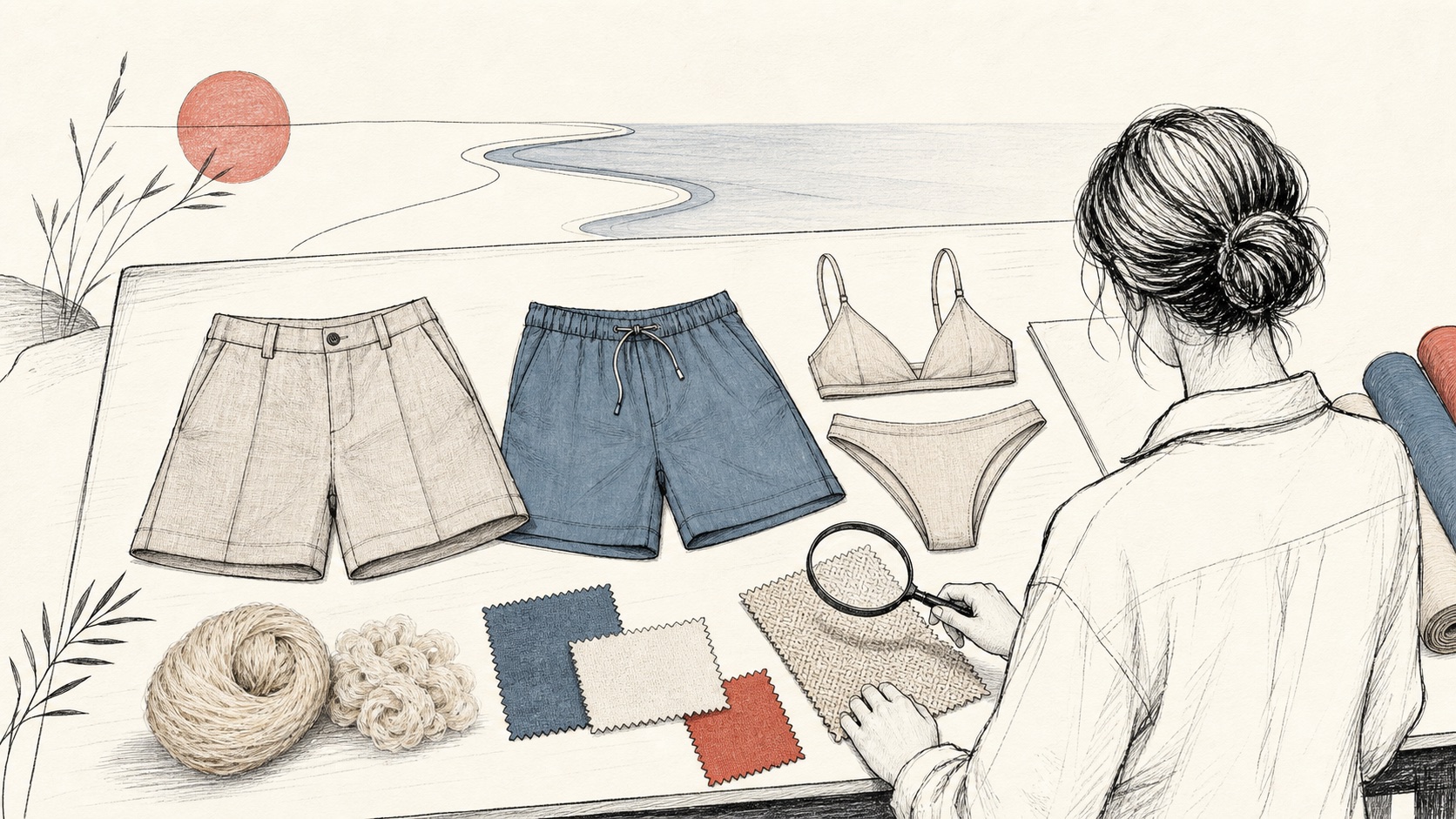
The brand had one rule: use natural fibers wherever possible.
Wool, silk, cotton, and hemp shaped its products and its identity. Then the Australian founders moved into beachwear, where fabric has to stretch, recover, tolerate water, and dry without becoming unpleasant to wear.
That put the brand promise under pressure. Standard nylon or polyester swimwear would have solved much of the performance problem and weakened the idea behind the company.
Questions such as "Can a bikini be made from wool?" or "Can board shorts be made from cotton?" do not have universal yes-or-no answers. Every material brings advantages and limitations. The right recommendation depends on how the garment will be used, who will buy it, what that customer values, and which compromises the brand is willing to accept.
Some founders arrive with a material idea before they have defined the audience or the open space in the market. We help them work through that too. In this case, the opportunity was a rare one: super-premium beachwear for customers who cared enough about natural fibers to accept different performance from conventional synthetic swimwear.
100% wool
Verified YKK zipper, premium chain stitching, and a gusset replaced weak construction.
120 GSM Supima cotton
A tight weave balanced low weight, useful structure, and a premium hand.
96% wool, 4% spandex
A rare woven stock fabric provided the structure the customer preferred.
The wool walk short looked better than it was built
The customer had already sold a version of its wool walk short through another provider. From the outside, it looked like a finished premium product.
Our production team found the problems within seconds of handling the sample.
The zipper carried YKK branding, but our team determined that it was not genuine. It did not run smoothly. The sewing and internal construction also fell short of what the fabric and price point demanded.
A founder may see the right silhouette, color, and wool. An experienced sample maker checks how the zipper travels, how the seams carry strain, and what happens when the wearer moves.
NewWay rebuilt the short with a verified genuine YKK zipper, premium chain stitching, and a gusset for strength and movement. YKK warns that counterfeit components may fail to meet expected performance standards and recommends purchasing through authorized channels.
The revised walk short was delivered without a reported quality problem.
Can board shorts be made from cotton?
The answer depends on the customer and the intended use. Cotton absorbs water, so it will not behave like a lightweight synthetic board-short fabric. A brand can still choose cotton when natural composition, hand feel, and market position matter more than the fastest possible drying time.
The customer wanted an unusually light fabric with a premium feel. NewWay sourced a tightly woven 120 GSM fabric made from 100% Supima cotton. The low weight kept the short light. The tight weave gave that weight more structure, while Supima's extra-long fibers produced the smoother hand the brand wanted.
We did not sell cotton as a synthetic performance fabric. It still absorbs water. The customer accepted that limitation because natural material content sits at the center of the product.
Our rule for unusual fabrics: explain what the material gains, what it gives up, and which customer will value that trade-off. The same fabric can be the right answer for one market position and the wrong answer for another.
Is wool good for swimwear?
There is no universal yes or no. Wool offers a premium natural story, breathability, and a distinctive hand. It does not behave like the synthetic stretch knits used in most modern bikinis, especially after direct contact with water. Whether it works depends on the construction, the intended use, and what the target customer expects from the product.
Woolmark describes wool as hygroscopic, which means the fiber absorbs moisture from its surroundings. That property helps wool manage moisture vapor in activewear, but liquid water creates a harder design problem for swimwear.
The customer's previous option was an expensive Italian wool fabric with a polyurethane coating. The coating was meant to improve durability and protect the wool from water.
When our team stretched the physical sample, the coating did not remain continuous across the opened fabric structure. Parts of the wool structure became exposed. That visual inspection gave us enough concern to search for another route.
We did not run a laboratory test on the Italian fabric, so we will not present that observation as a scientific verdict. It was a production decision made after handling the material in the way a bikini would be used.
Searching China for an uncommon wool-stretch fabric
NewWay contacted fabric agents in Guangzhou, Shaoxing, and other textile markets. More than a dozen wool suppliers joined the search. Only one held a small quantity of an in-stock woven wool-stretch fabric that matched the brief.
We gave the customer two real options and explained what each one gained and gave up.
| Fabric option | What it did well | Limitation found in testing |
|---|---|---|
| 94% wool, 6% spandex knit | Softer hand and more stretch | Absorbed more water |
| 96% wool, 4% spandex woven | More structure for the bikini shape | Less soft than the knit |
The customer chose the woven fabric. Supplier records confirmed its composition, Australian wool origin, and machine-washable specification. NewWay and the customer both tested it before approving production.
We are not claiming that the finished wool bikini performs like conventional synthetic swimwear. It was the option the customer preferred after seeing the trade-offs within its natural-fiber-led brief.
The service happened in the difficult conversations
Unusual products create small problems throughout development. A fabric may feel right and behave differently when stretched. The softer choice may take on more water. An expensive reference may prove less suitable than a lower-priced alternative.
We kept the founders updated through WhatsApp. Good news, bad news, product questions, and cost consequences went through the same channel. When a choice changed performance or price, we presented the options and explained the trade-off.
"NewWay and Ray were on top of everything, from the tech pack and design to fabric sourcing and production. Ray is a native English speaker, which made communication extremely easy. His team had the expertise to take the project from an idea to a market ready product without requiring a separate tech pack designer, sourcing manager, or QC team. They handled everything under one roof and delivered high quality service."
Anonymous Australian brand founder
For a smaller brand, that removed the need to coordinate a separate tech pack designer, fabric sourcing manager, factory contact, and quality team. One group carried the decisions from the first idea through production.
What happened after delivery?
NewWay completed approximately 1,000 pieces across the walk short, board short, and bikini. The customer reported no quality problems, told us the products sold very well, and is placing repeat orders.
We do not know its sales figures or sell-through percentage. The sales assessment comes from the customer. Repeat ordering provides the additional result we can verify directly.
The brand also gained an approved production route for three difficult products. The fabrics, components, patterns, and construction decisions can now support future orders without restarting development from zero.
What another natural-fiber brand should take from this project
A strong material principle creates constraints. Those constraints can also reveal open space in the market.
Start with use. A wool walk short needs dependable hardware and seams. A cotton board short needs tight control of weight and weave. A wool bikini needs stretch, structure, and water testing before production.
Reference fabrics help a manufacturer understand direction. A premium price or country of origin cannot prove that the fabric suits the garment. Stretch it. Wet it. Wash it. Build the sample, then decide.
Our role was to explain the advantages and limitations, connect them to the intended customer, and recommend a path. This brand chose an uncommon position: super-premium wool swimwear and natural-fiber shorts for buyers who valued the material story. Few brands pursue that space, which gave the products a clear reason to exist.
Sources and disclosure
- Project quantities, materials, customer feedback, and outcomes: NewWay production records and Ray Wang interview, June 2026.
- Woolmark: Wool is naturally breathable.
- Supima: The cotton.
- YKK: Anti-counterfeiting measures.
- The customer quotation is exact and published anonymously with permission. Sales figures were not provided.
Developing an unconventional natural-fiber product?
Bring the material principle and intended use before committing to a fabric. NewWay can compare constructions, search specialty stock, build the tech pack, test samples, and carry the approved product into production.
Discuss Your Project